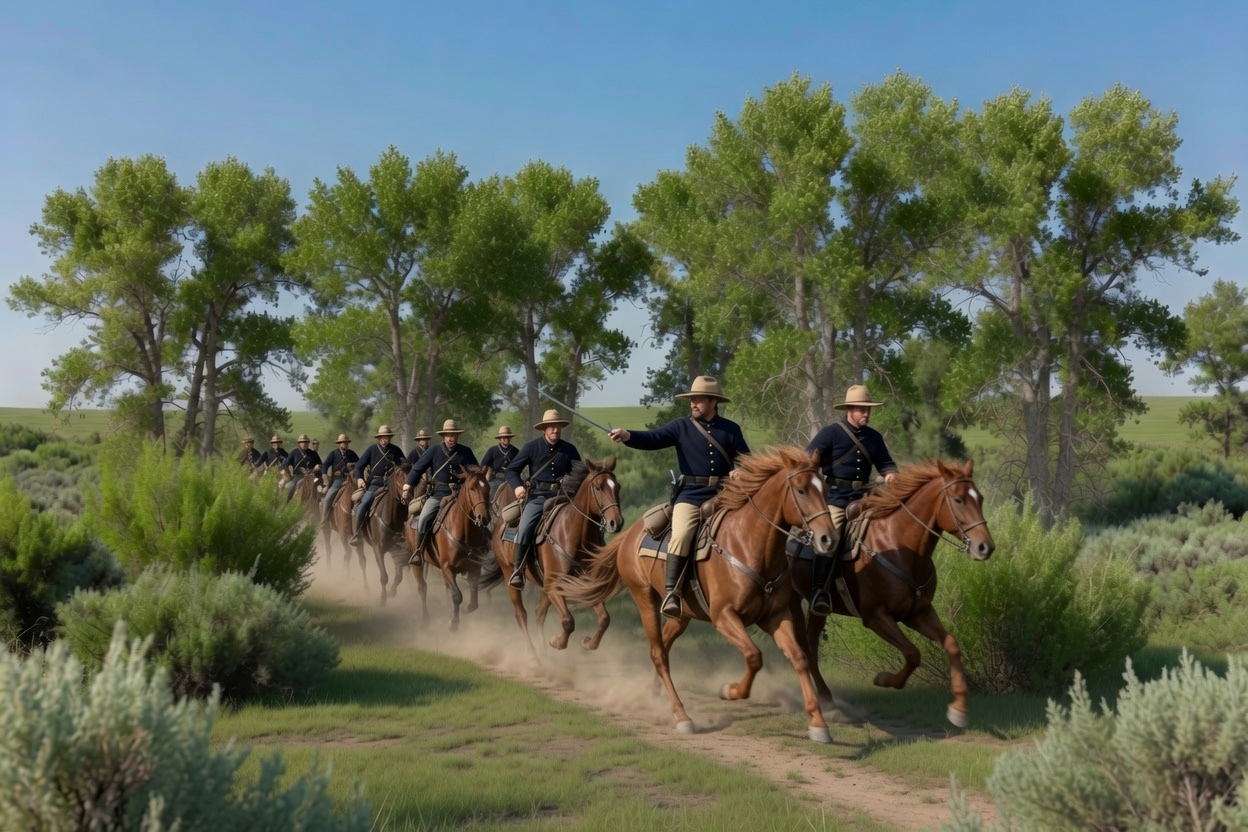
AI generated image. As Reno’s battalion splashed into the Little Bighorn at Ford A, discipline briefly gave way to exhaustion. Men slumped in their saddles, and thirsty horses balked at the crossing, lowering their heads to drink as if oblivious to bugle calls and shouted commands. The long, hot march had taken its toll. Dust, heat, thirst, and fatigue combined to erode the battalion’s order at the very moment it entered the river. For several minutes, the ford became a scene of confusion as horses crowded together in the stream and formations dissolved into a tangled mass of troopers, mounts, and swirling water. Neither command nor encouragement could persuade the thirsty animals to move on until they had drunk their fill of the cold river. Only after the crossing was completed did Reno’s battalion gradually reform and regain its cohesion on the far bank, preparing to advance toward the hidden village beyond.
Ford A was the site where Major Marcus Reno and his battalion crossed the Little Bighorn River on June 25, 1876. For generations, historians and battlefield enthusiasts accepted the location shown on the Marshall Map as the crossing point. Recent research, however, has demonstrated that the traditional location was incorrect.
New evidence published in 2026, based on the Thompson-Tweedy Map, places the actual crossing several hundred yards downstream from the traditionally identified Ford A. The discovery resulted from a combination of historical and archaeological research. Dennis Fox, brother of noted Little Bighorn historian Dr. Richard Fox Jr., located a topographic map prepared by Thompson and Tweedy and compared it with a pre-1940 photograph taken by Kenneth Roahen showing an early stage road crossing the river. The photograph, later used on postcards, helped researchers pinpoint the location of the historic ford.
Subsequent archaeological investigations of the area produced compelling evidence. Researchers recovered a significant concentration of military artifacts associated with Reno’s battalion at the newly identified crossing site, strongly supporting the conclusion that the traditional location had been misplaced.
This important revision to the battlefield’s geography is detailed in “Reno’s First River Crossing: And Mysteries Created by Newly Discovered Artifacts” by Jason Pitsch, Douglas D. Scott, and Michael Donahue, published in Greasy Grass: The Journal of the Custer Battlefield Historical and Museum Association, Volume 42 (April 2026).
Oglala Gray Whirlwind spotted a blue cavalry line on the high bluffs on the opposite side of the river. At the same time after crossing Ford A, several soldiers in Reno’s column saw several figures on what they thought was Weir Point but was actually further back on Sharpshooter Ridge, what they believed was Custer and, perhaps Captain Tom Custer, Lt. Cooke and possibly scout Mitch Bouyer.
The Famous 7th U.S. Cavalry guidon.
The discovery demonstrates that even after 150 years, new evidence continues to refine our understanding of the movements of Reno’s battalion and the opening stages of the Battle of the Little Bighorn.
AI generated image. Major Marcus Reno led his battalion at a gallop down the Little Bighorn Valley, convinced that he was closing in on a nearby Indian village. The village was indeed ahead, but it remained hidden behind a curtain of cottonwoods, brush, and bends in the river. To the advancing troopers, the valley appeared strangely quiet. Only a few young pony herders could be seen darting across the landscape—figures who seemed more surprised than threatening.
Beneath this calm surface, however, alarm was spreading rapidly through the immense Lakota and Northern Cheyenne encampment that stretched for miles along the river. Women hurried to move children and the elderly to safety. Some families began striking their tipis and loading possessions onto pony-drawn travois, while warriors rushed to gather weapons, mount their horses, and respond to the attack.
Despite encountering only scattered resistance from a handful of warriors appearing here and there on the valley floor, Reno abruptly halted his advance approximately 500 to 600 yards short of the village. At that moment, the defenders remained in a vulnerable state of transition. Many warriors were occupied helping their families escape, while others were only beginning to organize a fighting withdrawal beyond the timber.
The brief window of opportunity was rapidly closing. Although the valley still appeared relatively calm, the situation was on the verge of erupting. Within minutes, increasing numbers of Lakota and Northern Cheyenne warriors would converge on Reno’s battalion, transforming the quiet advance into one of the most dramatic and fiercely contested actions of the Battle of the Little Bighorn.
AI generated image. Timber Dismounted Skirmish Line
Major Marcus Reno had been given the honor—and responsibility—of leading the attack on the Indian village reported to be somewhere ahead. Yet as his battalion advanced up the Little Bighorn Valley, there was still no sign of the village itself. A dense screen of cottonwoods and brush concealed the immense encampment from view.
Reno’s troopers first encountered only a few young pony herders attempting to drive their animals back toward the village, where the warriors would soon need fresh mounts. A handful of camp guards also appeared, preparing to oppose the Arikara scouts whom Custer had sent ahead to capture horses and disrupt the mobility of the village. Earlier, the Arikara scouts had encountered a father and son searching for stray ponies. In the brief clash that followed, the boy was killed, while the father escaped and raced back to the village with a warning that soldiers were approaching.
As Reno reached the timber, the valley curved to the right, but the village remained largely hidden behind the thick stand of trees lining the river. Only a few camp guards could be seen. At this critical moment, Reno unexpectedly ordered a halt. Some of the troopers welcomed the pause, uncertain of what lay ahead beyond the cottonwoods.
Reno then deployed his battalion into a mounted skirmish line. The soldiers opened fire on the small number of visible Indians, but at such distances the carbines were not particularly effective. What had begun as an aggressive charge now became a stationary firefight.
Reno’s Skirmish Line formed along the red line from the Timber on the bottom to what was then trees and bushes where the railroad is today.
The pause proved costly. With the cavalry no longer advancing, warriors who had been helping their families flee or hurriedly gathering weapons were given valuable time to respond. One by one, then in growing numbers, Lakota and Northern Cheyenne warriors joined the camp guards, steadily strengthening the defense that Reno would soon have to face.
The Timber was a sprawling grove of cottonwood trees, dense brush, shrubs, and uneven ground bordering the Little Bighorn River. Over centuries, the river had shifted back and forth across the valley floor, carving new channels and leaving behind old riverbanks, swales, and undulating terrain. In 1876, this wooded area extended far into the valley bottom in the area now known as the Garryowen Loop, reaching almost to the low rolling hills south of the river. Beginning near the small Garryowen station, buffalo trails crisscrossed the Timber, cutting pathways through the thick vegetation and winding up and down the ancient banks.
AI generated image of fighting from Timber.
When Reno’s battalion withdrew into the Timber, the position appeared well suited for defense. The trees and brush provided concealment, while the broken ground offered cover from enemy fire. Many Lakota and Cheyenne warriors later stated that the soldiers occupied a strong position and could have held out there for a considerable time.
For roughly twenty to thirty minutes, Reno’s command maintained its stand among the cottonwoods. Then tragedy struck. A bullet killed Bloody Knife, Reno’s trusted Arikara scout, as he stood beside the major discussing the situation. Witnesses recalled that Reno was sprayed with blood and brain matter, an experience that appeared to have a profound effect on him. Shortly afterward, his orders became confusing and inconsistent. He ordered the battalion to mount, then dismount, and then mount again.
Reno ultimately decided to abandon the Timber and retreat toward Ford A. The withdrawal quickly became chaotic. Many troopers never heard the order, and one company was temporarily left behind. Numerous soldiers later expressed surprise that Reno chose to leave what they believed was a defensible position. The retreat was further complicated by the narrow buffalo trails winding through the woods. Instead of riding out in broad formations, the cavalrymen were forced to move in single file or in pairs, creating congestion and disorder.
Warriors positioned outside the Timber were initially astonished when the soldiers suddenly emerged and began to fall back. Realizing the cavalry was retreating, they pressed the attack aggressively. Skilled Lakota and Cheyenne horsemen rode alongside the fleeing column, firing arrows and bullets at the soldiers and their horses. Others used war clubs, hatchets, and rifle butts against isolated troopers caught in the confusion. The leading companies escaped before many warriors could react, but those farther back encountered increasingly fierce resistance. The final company to emerge—having received little or no warning of the retreat—found itself facing a growing mass of determined warriors.
Neither Reno nor any other officer established a defensive line to protect the crossing at Ford A. The crossing itself was difficult. It was not a broad, gently sloping ford; the riverbanks on either side rose approximately three to five feet above the water, creating a bottleneck as men and horses struggled to climb in and out of the stream. Under relentless attack, the retreat disintegrated into a desperate race for survival. By the time the survivors reached the bluffs leading to Reno Hill, roughly thirty of the approximately 160 soldiers who had entered the Timber had been killed during the fighting and retreat.
One of the more poignant stories from this phase of the battle concerns Isaiah Dorman, Custer’s interpreter. Dorman was of African American and Lakota ancestry and had lived among the Lakota after marrying a Lakota woman. During the retreat from the Timber, he was severely wounded and unable to continue. As Lakota women moved across the battlefield attending to relatives and dispatching mortally wounded soldiers, Dorman reportedly spoke to them in Lakota, telling them not to hurt him further because he was already dying. According to later accounts, the women rebuked him for fighting against his wife’s people and called him a traitor, but they did not inflict additional suffering. Dorman soon died of his wounds. Despite his unique place in the history of the battle, no authenticated photograph of Isaiah Dorman is known to exist.
Reno orders the battalion to mount up and charge out of the Timber and eventually made for Reno Hill across the Little Bighorn River.
While Major Reno and the Arikara scout Bloody Knife discussed the worsening situation in the timber, Lakota warriors continued to work their way closer through the brush and ravines. Custer’s promised support had not appeared, and Reno was becoming increasingly concerned about the security of his position. During their conversation, an unseen warrior’s bullet struck Bloody Knife in the head, killing him instantly. Blood and brain matter splattered across Reno’s face and clothing, shocking the battalion commander at a critical moment.
Almost immediately afterward, Reno began issuing hurried orders. Witnesses recalled a confusing sequence as he ordered the men to mount. Soldiers nearest their horses broke from the firing line and moved to retrieve them. In the noise, dust, and confusion of battle, the order was not relayed uniformly throughout the Timber. Reno, appearing shaken and uncertain, briefly called for the men to dismount, then reversed himself and again ordered them to mount. Finally came the command to charge out of the timber.
AI generated image. Reno’s withdrawal from the Timber carried his battalion directly into a growing semicircle of Lakota and Cheyenne warriors. Fighters had already taken positions around much of the Timber’s outer edge, meaning the warriors immediately in front of the breakout represented only part of the force gathering to oppose the soldiers. This initial deployment worked to Reno’s advantage, allowing the first unit to emerge with relatively little resistance. Company A, leading the withdrawal, passed through before many warriors fully realized what was happening. Company G, following behind, encountered stiffer resistance as increasing numbers of Lakota and Cheyenne warriors converged on the escape route, drawn by the sounds of gunfire, shouting, and galloping horses. Company M fared the worst. Delayed in the Timber and apparently unaware of Reno’s orders, its men remained behind during the critical opening moments of the retreat. When they finally emerged, they did so in disorder and directly into a greatly enlarged concentration of warriors. Forced to fight their way through determined attackers, Company M suffered heavily as it struggled toward the river. AI generated image. The steep riverbank proved hazardous for the retreating cavalry. As horses scrambled over the edge, several troopers were thrown from their mounts. Behind them, Lakota and Cheyenne warriors skillfully guided their ponies down the bank and into the water, rapidly closing on the rear of the column. What had begun as a retreat was quickly turning into a desperate fight for survival. Captain McIntosh was killed during the retreat to the river. Lieutenant Hodgson was killed during the crossing of the river, while many historians regard the river crossing itself as the point at which Reno’s battalion suffered its greatest losses in the engagement.
The surviving troopers who reached the Little Bighorn River discovered that no organized defensive position had been established at the crossing later known as Reno Crossing. Rather than stopping to organize a rear guard or rally the retreating companies, Reno crossed the river and pushed rapidly up the bluffs to the east. Critics later argued that his failure to establish a defensive stand at the river contributed to the disorder of the retreat and increased the battalion’s losses, while defenders maintained that any attempt to hold the crossing would likely have resulted in the destruction of the command. The debate remains one of the most controversial aspects of Reno’s conduct during the battle.
Several officers and noncommissioned officers attempted to stem the panic and establish a defensive line near the river, but their efforts met with only limited success amid the confusion. What had begun as a withdrawal from the timber had devolved into a desperate struggle for survival as Lakota and Cheyenne warriors pressed the attack from multiple directions. Soldiers crossed the Little Bighorn individually or in small groups, often under heavy fire and with little regard for unit cohesion. In the chaos, command and control largely broke down, leaving many men to act on their own initiative as they fought their way across the river and toward the bluffs beyond. The retreat inflicted severe losses on Reno’s battalion and left the survivors shaken, disorganized, and scattered before they eventually regrouped on the heights later known as Reno Hill.
Company M suffered some of the heaviest losses during the retreat, while soldiers from all three companies were killed, wounded, or cut off amid the chaos. The battalion’s withdrawal had become a desperate race for survival. Men fell in the river, on its banks, and on the steep climb to the bluffs beyond. By the time the survivors reached the high ground later known as Reno Hill, the battalion had been badly battered and much of its unit cohesion had disappeared. There, shaken survivors and exhausted officers worked to reassemble the command and hastily establish a defensive position before the warriors could renew their attack.
The chaotic retreat from the timber, across the Little Bighorn River, and up the eastern bluffs remains one of the most controversial episodes of the Battle of the Little Bighorn. Supporters of Major Reno argued that he acted to save his command from encirclement and possible destruction, maintaining that the timber position had become untenable under mounting pressure from Lakota and Cheyenne warriors. Critics, however, contended that the disorderly withdrawal unnecessarily increased casualties, abandoned a defensible position, and contributed to the collapse of battalion discipline at a critical moment in the battle. More than a century later, historians continue to debate whether Reno’s retreat represented a necessary tactical decision or a lost opportunity to maintain an organized defense in the valley.
Reno Hill: During the first night and into the following day, Major Reno when Captain Benteen arrived and they worked together in directing the defense. At times Reno issued the formal orders, but Benteen—and occasionally Captain Weir—did not hesitate to press their own strongly held views on how the position should be held. Throughout this uneasy command arrangement, Lakota and Cheyenne warriors kept the hilltop under relentless pressure. For three days and two nights they poured in rifle fire, crept close through ravines and tall grass, and repeatedly probed the perimeter, seeking an opening through which to overrun the soldiers’ fragile position.Army Scout Bobtail Bull and several soldier markers commemorate participants in the Reno Hill–Timber fight. Although the landscape has changed considerably over the past 150 years, the wooded area visible to the right marks the general location of the Timber, from which Reno’s battalion made its desperate retreat toward the river and the bluffs beyond.AI generated image. After a tense and nearly sleepless night, the new day brought intense heat and a renewed struggle for survival. As the sun climbed higher, the men on Reno Hill discovered that many of their canteens were empty. Everyone suffered from thirst, but the wounded endured the greatest misery, lying exposed beneath the relentless summer sun while fever, pain, and dehydration steadily consumed their strength. In response, a handful of volunteers stepped forward to undertake one of the most dangerous tasks of the siege. Using the shelter of the ravine that would later become known as Water Carriers Ravine, they cautiously made their way toward the Little Bighorn River. Under cover of darkness—and sometimes even in daylight—they crept down the ravine in hopes of reaching the water and returning alive. While the ravine provided some protection, the riverbank itself was exposed to warriors positioned along the opposite shore. The missions were fraught with danger and met with mixed success. Some of the volunteers were wounded; others were killed outright. Yet despite the risks, precious water was carried back up the ravine to the hilltop, providing desperately needed relief to wounded and exhausted soldiers. Driven by thirst but sustained by extraordinary courage and selflessness, these men repeatedly risked their lives for their comrades. Their bravery did not go unrecognized. Nineteen soldiers who participated in the perilous water-carrying missions and were killed or wounded during the effort were later awarded the Medal of Honor, making the defense of Reno Hill one of the most highly decorated actions in American military history.View of Sharpshooter Ridge and Weir Point behind the dark high point with a notch in the middle. Custer was able to look south into the valley and see Reno as he was beginning his charge down the valley. Several soldiers spotted Custer from Reno’s formation to charge and though he was standing on Weir Point. From here, Custer looked southwest over the bluffs and could see part of the village. NPS
Captain Thomas B. Weir, one of Custer’s closest friends, grew increasingly frustrated as the afternoon wore on. He was dissatisfied with Captain Frederick Benteen’s decision to halt and consolidate with Reno rather than press forward after receiving Trumpeter John Martin’s urgent message from Custer. Weir was equally troubled by Reno’s reluctance to advance toward the heavy firing and rising dust visible to the north. Convinced that Custer was heavily engaged, Weir eventually moved his company forward without waiting for orders, advancing to the prominent ridge later known as Weir Point. Ironically, the caution shown by Reno and Benteen may have spared their command from destruction, as any substantial advance beyond Weir Point would likely have brought them into direct contact with hundreds of Lakota and Cheyenne warriors returning from the fight against Custer’s battalion. The rapidly approaching warriors soon convinced Weir and the others that their advanced position could not be held, forcing a withdrawal back to the Reno-Benteen defensive perimeter.
Determined to discover what had become of Custer, Captain Thomas B. Weir finally acted on his own initiative. Frustrated by the continued inactivity of the Reno-Benteen command, he mounted up and led Company D toward the prominent ridge later known as Weir Point. His troopers followed without waiting for further orders. From the high ground, Weir hoped to locate Custer’s command and identify the source of the heavy firing and rising dust visible to the north.
As Weir advanced, Benteen and the other company commanders eventually followed. Whether Benteen was motivated by concern for Custer, a sense of duty, or second thoughts about not immediately complying with the urgent request delivered by Trumpeter John Martin can only be a matter of speculation. What is certain is that he ordered his company forward, and the remainder of the Reno-Benteen force gradually moved in the same direction.
As Company D reached the ridge, Weir looked across the valley toward the distant hills where the battle had raged only a short time before. There he and his men observed large numbers of mounted Lakota and Cheyenne warriors moving across the landscape, along with scattered clouds of dust marking the scene of intense fighting. Other officers and companies soon followed Weir’s advance, but any hope of reaching Custer quickly faded as increasing numbers of warriors began converging on their position. Realizing the exposed ridge could not be held against a determined attack, the Reno-Benteen command was forced to withdraw to its defensive perimeter on Reno Hill.